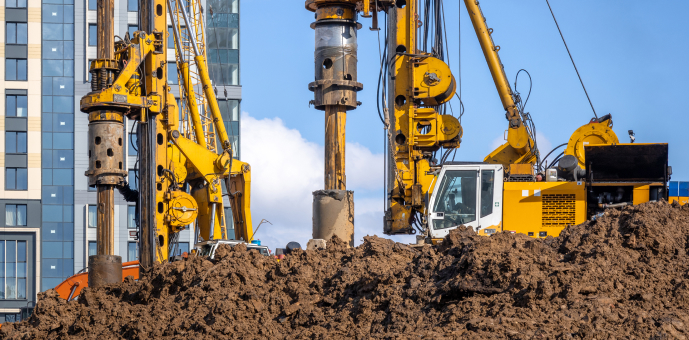
Ground anchors are high-tensile steel tendons drilled or driven into the ground and tensioned against a structural element to provide active restraint. They are used to hold retaining walls, slopes or deep excavations in place and are specified where lateral loads need to be resisted rather than relying solely on passive soil pressure.
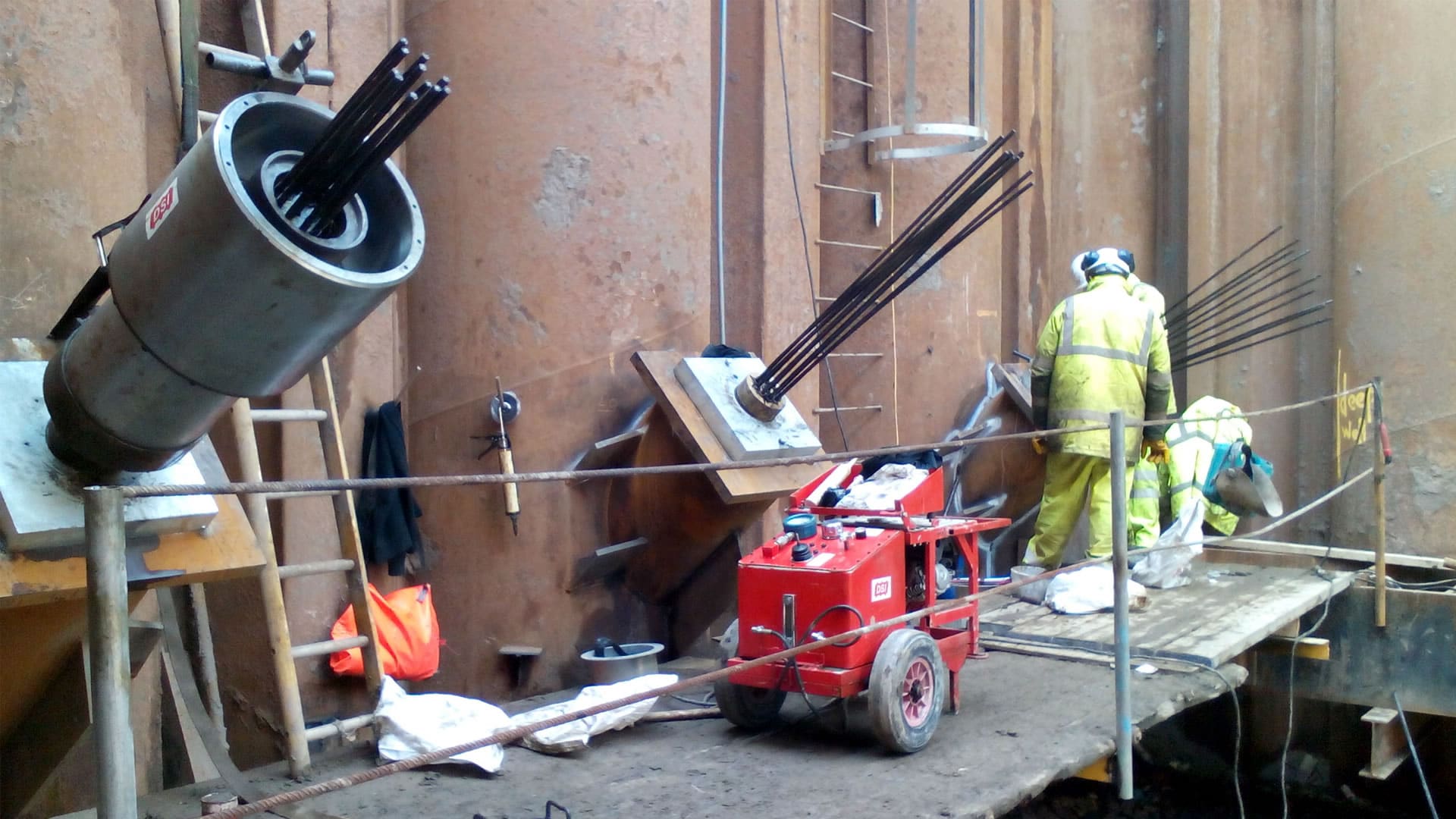
Basic Technique
What is a Ground Anchor?
A ground anchor is a structural member, which can transmit an applied tensile force to a load bearing stratum. The main application on existing structures is to prevent horizontal movement of retaining walls, bridge abutments, etc. In new construction, anchors are used to retain sheet piles, bored pile walls and steel tubes. Anchors may be inclined or vertical, passive, pre-stressed, temporary or permanent.
Quinn Piling have a range of rigs ranging from 3t to 30t which provide the capability to install ground anchors, soil nails and tie rods in all types of ground conditions and with most types of access restrictions. We have also developed a number of specialist remote-controlled anchor rigs for more challenging applications where standard equipment might not be suitable or productive.
Our capability to offer in-house design allows Quinn Piling to react quickly to site conditions and provide efficient solutions, thereby reducing project timescales and minimising cost.
Our drilling rigs are capable of installing tie-rods for stabilisation of bridges and other structures. Ties can be installed horizontally or on an incline through masonry, concrete, fill and natural soils.
These ground-anchor and soil-nailing solutions are quite often installed in conjunction with other services offered by Quinn Piling. Our multi-disciplined project teams are able to manage the overall process giving the client a single point of contact, eliminating interfaces and ensuring the project runs smoothly.
We offer a complete design and installation service for all types of building and civil engineering projects, utilising experienced operatives and the latest plant and techniques.
Advantages
- Economical and practical alternative to propping
- Allows for open excavation, without obstruction from shoring or props
- Versatile form of earth retention
- High loads can be obtained in relatively poor ground
- Can be used in a wide variety of soil conditions
- Used to install ‘active’ forces into structures
Some typical examples of where Quinn Piling have been contracted to install ground anchors include:
- Tie-backs to flood walls
- Supports to temporary and permanent secant and contiguous retaining walls solutions
- Strengthening of dock / quay wall structures
- Stabilising marine structures
- Rockface stabilisation
- To resist hydrostatic uplift pressures
- Anti-flotation for deep structures
- Bridge abutments
Anchor Types
Various different types of anchor are available to suit a particular application:
- Permanent anchors can incorporate full double-corrosion protection provided by two concentric corrugated UPVC ducts.
- Temporary anchors may incorporate a single duct or no corrosion protection.
- Removable anchors can be used where there are wayleave issues beneath adjacent properties.
A recent development has seen the introduction of multistage anchors. These can be used to improve efficiency and achieve high loads in poor ground through the use of multiple discrete unit bond lengths.
Tendons can be made of steel bar, wire strand or GRP and are fabricated under factory conditions. This is usually undertaken by an external supplier on smaller projects but for large projects Quinn Piling can set up dedicated manufacturing facilities.
Anchor holes can be bored using a variety of drilling techniques including rotary, top-drive rotary percussive, Down-The-Hole hammer and augering. In difficult ground conditions simultaneous drilling and casing systems can be employed to temporarily support the boreholes prior to installation of the anchors. The type of drill rig used will be dependent upon the access, working room and ground conditions. Quinn Piling have a wide variety of ground engineering drill rigs ranging in weight from 1.5 to 30 tonnes. When the bore hole is complete, the anchor is either lowered into a pre-grouted hole or post-grouted after installation using an integral primary grout tube. When the grout has achieved full compressive strength the anchor is stressed using a portable hydraulic jack and locked off against a head plate in accordance with British Standards. Re-stressable head blocks with load cells can also be provided for long term monitoring and adjustment if required.
Anchor capacities generally range from 100kN to over 3,150kN, with lengths of up to 70m. The capacity achievable depends upon the quality of the anchoring material and the tendon used. The anchor hole may be straight-shafted or under-reamed with bar or strand tendon.
Support & Anchoring Case Studies
See how we overcome complex ground challenges, deliver reliable solutions, and create lasting value for clients across a wide range of sectors.
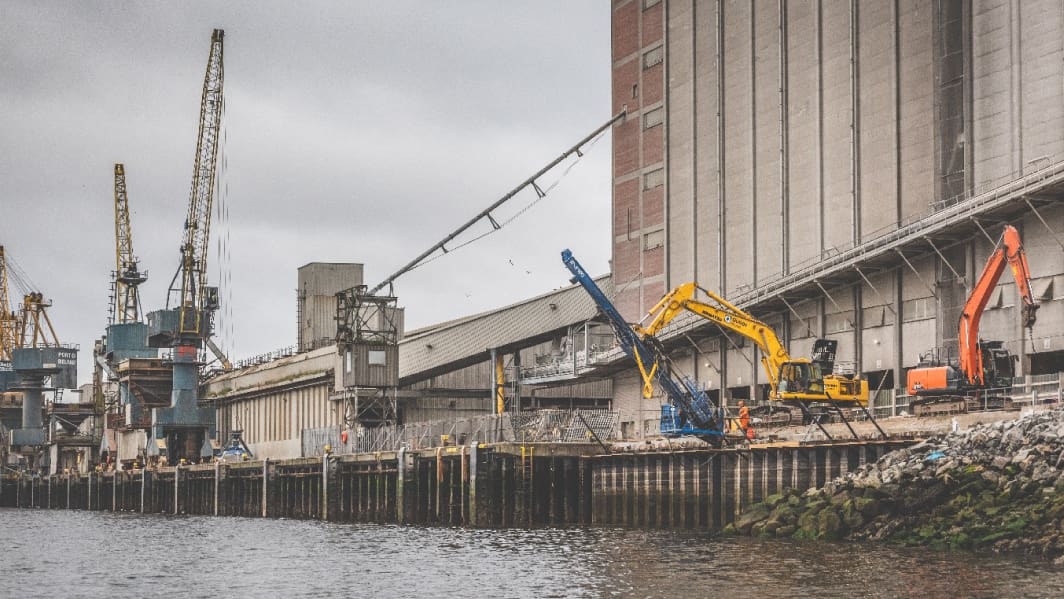
Belfast Harbour West Wharf Wingwall
Quinn Piling was commissioned to install 11 No. high capacity […]
Read Case Study